no-moe mr. nice guy
One of the downsides of watching a lot of movies (or consuming a lot of any kind of media) is the creation of hyperspecific taste that forms via a natural, synthetic1 process of being drawn towards the things that you are drawn to and hence being ‘shaped’ by the media you consume. When people talk about a taste ‘maturing’ this is one of the central tenets, after all—learning to discern what you like and what you don’t like, but in the information age where there is no limitation placed on the actual quantity of media available to you this can be quite a dangerous endeavor, often resulting in the centers of aesthetic appreciation in your brain being only activated by very specific stimuli, such as (my own woeful example) of cybergaze cinema. This niche moniker seems to refer to, as I state, ‘impressionistic longing in the dreamy cityscapes of the east,’ but really is more of an attempt to describe the aesthetic of one of my favorite movies of all time, Haru (1996, dir. Yoshimitsu Morita). In fact something like Chunking Express (also included in this list) has very little to do with Haru. The most I’ve actually seen something come close to it is Il Mare, which—apart from being shot in a similarish style—actually shares a plot similar to Haru, ie. love mediated via letters in the modern era.
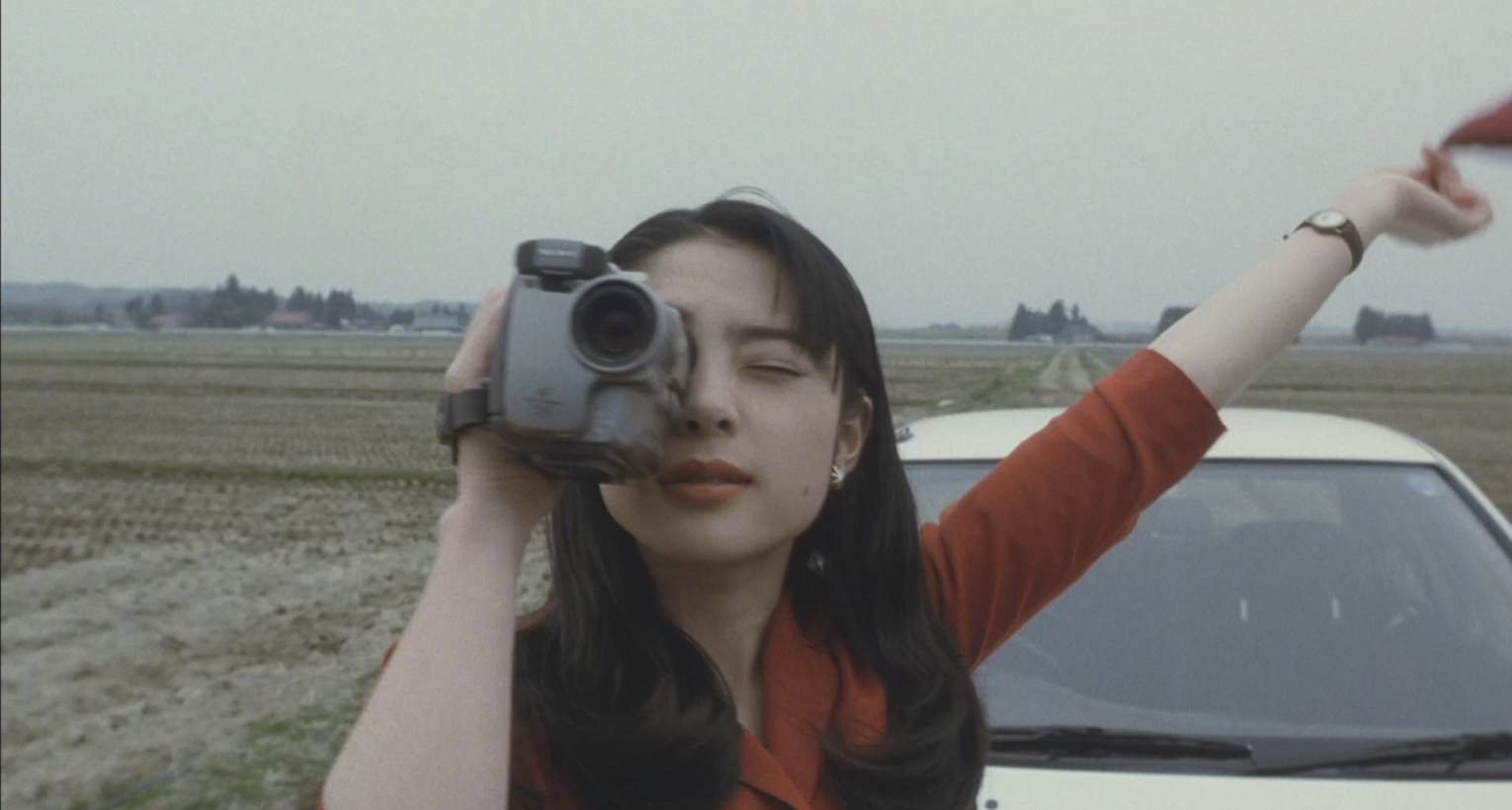
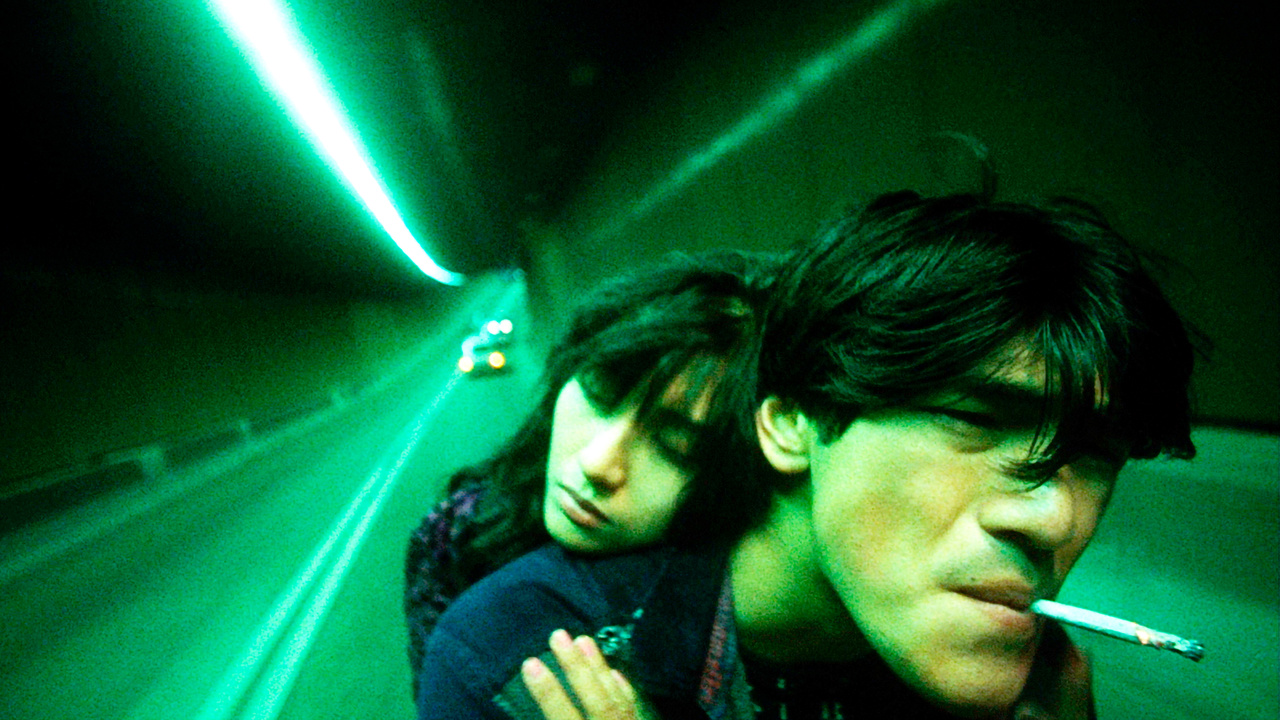
The entire reason I cultivated this whole collection of ‘cybergaze’ cinema in the first place is because there is a particular itch that Haru scratches which I was under the impression is interchangeable; that there is perhaps an intangible quality of this which can be placed on the production-line and utilized to provide me an endless number of such itch-scratching movies. Perhaps it may be worth interrogating what exactly it is that Haru provides. It is, after all, a movie which deals with several of the things that I concern myself with even just, like, in life: the interaction between the old and the new ways of doing things, love mediated by technology, lost decades and economic collapse, large cities, digital video, being lonely as an athletic man, early internet nostalgia… and when you connect with a movie on such a singular level what does it even mean to ‘replicate’ its appeal? The best you can do is find a superficial copy, and, yes, Fallen Angels, perhaps, does possess something of its nature, but ultimately is not—and can never be—Haru, inasmuch as could try… and it doesn’t.
So this whole cybergaze cinema experiment is ultimately a failure in terms of cultivation, but perhaps not in terms of synthesis, because the next step forward is clear: if there is a work of art I desire to exist, perhaps it is best to create that work of art? But how would I do this if a necessary prerequisite of that work of art is that it was of its time, and now we are no longer in that time? I have never been to Japan, and I did not exist in 1996, and my nostalgic longing for the world of Haru is based on a simulacrum, expressed to me via those same mediators; the internet, screens, and a directorial vision, a reflection of a world that was certainly never made for me or with me in mind.
weebery
Nevertheless, understanding the irrationality of the desire to inhabit that world does nothing to alleviate it; the desire persists. And I actually have watched a fair amount of the works that would serve as replacement: Hideki Anno’s Love & Pop, for instance (crucial lost decade media mediated through DV seems to summon up the Haru appeal more than simply plot, though that is probably a trite observation considering that cinema is a visual medium), or the works of Shunji Iwai, who is perhaps not coincidentally also Anno’s friend. And I love these works, don’t get me wrong, but they do not impact me as much as Haru, in which there is something inexplicable. And perhaps it is due to that very inexplicability that I have, naturally, arrived at Hideki Anno, possibly the foremost Japanese artist of his era.
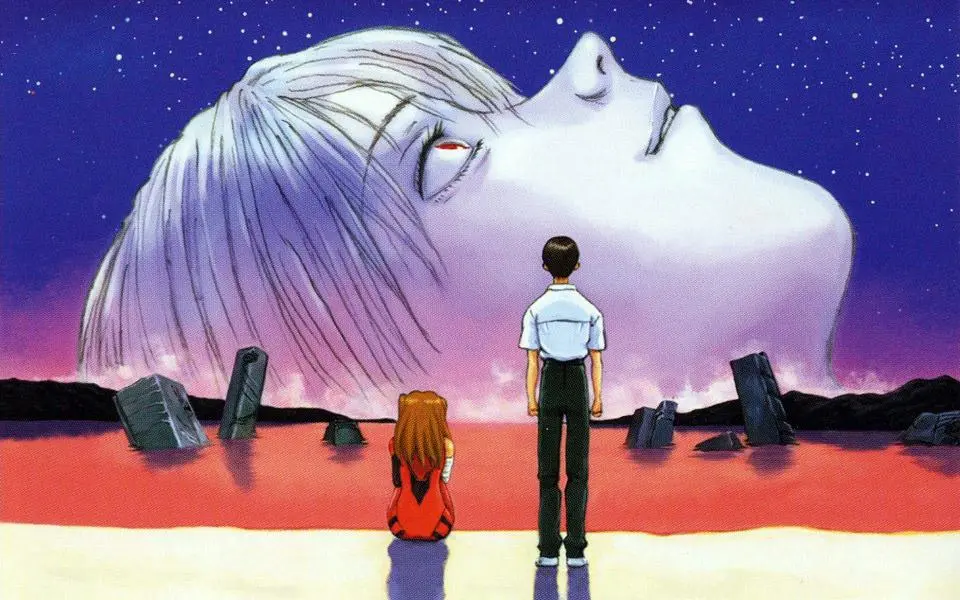
Anno—though holding my respect most for his 90s DV experiments Love & Pop and Ritual—is best known as the creator of Neon Genesis Evangelion2, which is perhaps the single piece of media most ripe to postmodern analysis. This makes it a very agreeable juncture for me to reach in this blog post because I don’t actually have to do that work: Hiroki Azuma does a lot of it in Otaku: Japan’s Database Animals, a monograph-length essay about the Japanese phenomenon of Otaku, or anime fans defined by their rapid consumerism and subcultural conformity3. Interrogating Azuma’s essay is worthwhile in its own right, but he does make several broad observations which are really well-framed and highlight why the precise engagement of ‘otaku’4 culture with art foregrounds certain characteristics of it that are most potent and yet least substantial—or, to put it more bluntly, why weebs have bad taste.
it’s all in the eyes
One of the things that Azuma calls attention to is the propensity of anime to converge into these kind of weird ‘cutesy’ or ‘kaiwaii’ (?)5 cat-girl figures. This stuff is basically everywhere; take a look at this collection of cat-girls holding programming books. Azuma calls their essential characteristics (tails, large eyes, small torsos) moe-elements, though I am unfamiliar with the origin of the term: perhaps in a more general sense they are the atomic units of this cutesy aesthetic that anime culture flaunts, and as such can be used to refer more generally to such units even in other aesthetics; it is of course not coincidental that anime ‘converged’ onto this particular kind of aesthetic6, having roots in the infantilization of Japanese culture following the impact of the bombs, war atrocity cover-ups and a generation that grew up in one of the world’s great economic ‘miracles,’ but nevertheless simply viewing the earliest anime makes it inessential that the particular aesthetic it would converge upon was this cutesy, unserious one and not one that was rooted in, say, dark and garish cyberpunk imagery, which was already a staple of the genre. In any case, it is not incorrect to be able to identify such moe-elements outside of anime—such when it comes to my own taste, the atomic elements of digital video (with the associated chromatic aberration), slow-falling autumn leaves in handheld, a backdrop of melancholic music with freeze-frames of pretty women just being themselves… like any ‘otaku,’ I could go on and on. These units of aesthetics are essentially everywhere, and the nicheness of my taste is not actually enough to render me very different from a Swiftie7, though it perhaps does render me different from a pre-modern patron.
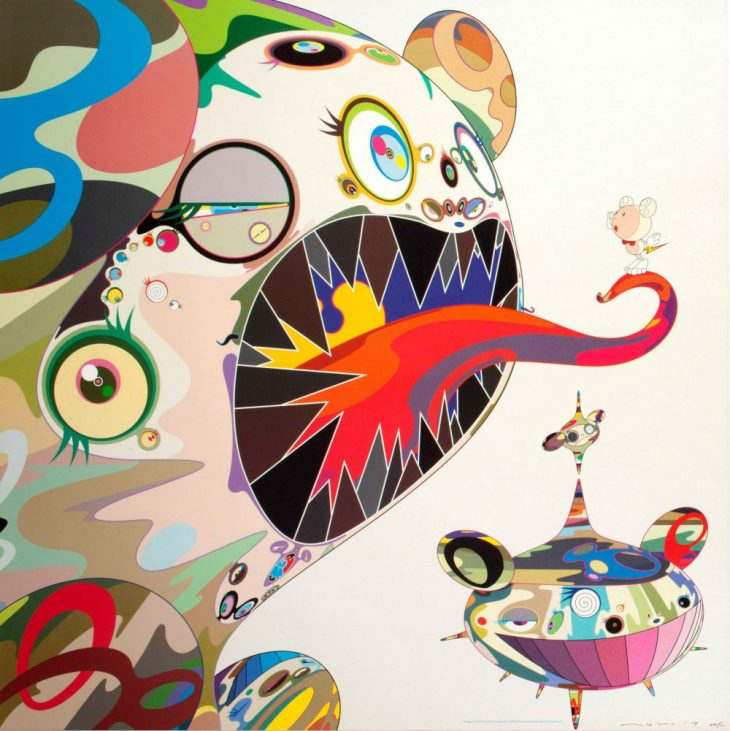
Simply identifying moe-elements as moe-elements achieves little8. The whole point is that they go from the base units of the aesthetic to the base units of consumption. In Baudrillardian fashion, the ‘problem’ is that otaku seem to be less appreciative of the stories and characters that these moe-elements derive from rather than the moe-elements themselves—artistically putting the cart before the horse, so to speak—and therefore can be drawn to ‘media’ that is less any kind of personal artistic expression and more some amalgamation of appropriate moe-elements, (like, uh, Girls und Panzer). Instead of a deeper grasp of the substance matter, the ‘otaku’ is driven towards radical consumption of the moe-elements themselves, which is quite an excellent marriage of postmodernity and late capitalism: (1) certainly skipping over the substance allows for faster and more superficial, and therefore more consumption, but also (2) the ease of manipulation of moe-elements also allows for faster creation. This might be something that is best expressed in anime culture, but is something that is really found in all kinds of low art: take the relentlessness of Colleen Hoover-style romance novels, or the cookie-cutter art of Brandon Sanderson9, or the kitschiness of fast food. What is the problem here? It’s a bit complex—for instance, simply an arrangement of moe-elements is certainly not enough to be ‘good enough’ to satisfy the ‘otaku’; a requirement is also the presence of the ‘otaku gene,’ purportedly something that Takashi Murakami’s10 Superflat aesthetic lacks: something that has been quite well-received in the world of contemporary art, though has received little love from ‘otaku’ due to not realizing moe-elements in the ‘intended’ manner. What Murakami’s example shows is that moe is just as much a sensibility through which to view anime content as it is the actual specifics of the content itself, and the process of moe-ification is one that can only be performed via a thorough study of what moe realizes.
This reminds me more than anything of this vague postmodern literary trend of ‘Dark Academia.’ Back in the day books were grouped by genre, and these genre consisted of major literary trends: crime, for instance, or romance; apt descriptors of what one was supposed to find within them to ease the publishing market. Once the readers became truly literate in the form of the novel, however, such simple categories no longer served there purpose—instead they fashioned more complex and dramatic subsections that served to capitalize on the narrowing specificity of the public taste. Dark Academia is one such genre; rooted in the old money ‘aesthetic’ of old New England falls and boarding schools, tall, byronic heroes and hidden/forbidden knowledge, it is lifted almost wholesale from Donna Tartt’s The Secret History11, leading therefore to a conundrum where the most successful works of the genre are essentially all knockoffs of a singular book. The Secret History is, of course, partly good because it does cultivate this immaculate vibe, but it is also good because it is well-written, well-plotted and contains stark scenes of original characterization, something that (like the non-moe aspects of anime) can be left by the wayside. The point is that the people consuming Dark Academia may consume quality, but quality is not something that they select for. Instead, their focus lands squarely on the presence of quillpots on an oakwood table.

hyperconsumerism
The question of course is why this is the case. A priori there should be no reason that readers fall out of love with sheer quality in favor of aesthetics; nevertheless, it happens, and has to do with the late-capitalist practice of hyperconsumerism. A good illustration appears in Roger Ebert’s critique of ‘fandom,’ best found in the following oft-quoted lines:
A lot of fans are basically fans of fandom itself. It's all about them. They have mastered the Star Wars or Star Trek universes or whatever, but their objects of veneration are useful mainly as a backdrop to their own devotion. Anyone who would camp out in a tent on the sidewalk for weeks in order to be first in line for a movie is more into camping on the sidewalk than movies.
A bit mawkish, perhaps, but there is a nugget of truth: while fans may not be into camping out on the sidewalk, they certainly aren’t into movies (otherwise they would instead just watch a movie). The psychology of someone camping out on the sidewalk is a curious one. The classical image is one of a hyperobsessive willing to wear physical discomfort to consume whatever they are buying the literal first moment possible12, but there must also be some amount of curiosity in the knowledge that this is obsessive fan-behavior; therefore to be a ‘true’ fan one must be camping, leading to the aforementioned people to enjoy neither the wait nor the camping but rather bask in the knowledge that they are a ‘true’ fan. In the social media panopticon, authenticity is hard to come by and one can’t really be caught ‘lacking’; taste becomes curatorial and can be expressed via the performance of it. After all, there’s something the machine—an amalgamation of all the tendencies of humanity, good or bad—sorely lacks: taste.

It is easy to believe that good taste is well-curated taste. But curation earns less money than rabid consumption, and so the market infrastructure evolves towards servicing ‘otaku’13. Market trends have rapidly evolved towards servicing hyperconsumers, or the ‘otaku’ that spend vast amounts of time and money on their media of choice over servicing universal audiences. Apart from being profitable (hyperfan concertgoers go to over 50 concerts a year and buy all the associated T-shirts, therefore consuming more than 10 of the ‘regular’ concertgoers who go to only 3-4 a year and buy one T-shirt and perhaps a signed album, so it’s a no-brainer as to who are the cash cows), this is also a self-replicating enterprise: as universal audiences are gradually alienated from hyperfan experiences, the next generation of content creators are also hyperfans—or ‘otakus’, whose base reference points now consist of already moe-ified anime, and hence do not have either the psychological or technical capability to express anything that isn’t moe-ified; the mind isn’t a computer, but it is undoubtedly true that what you get out is what you put in (it is notable that Girls und Panzer was not the first generation of moe-ified ‘otaku’ content; it was the result of several iterations). This of course is not limited to anime: consider Godard and Tarantino, essentially the Murakamis of the filmmaking world: films consisting entirely of moe-elements of Classic and New Hollywood, respectively. There was still quality to this even in the 90s, but now that Tarantino has been copied ad nauseam the result is a strangely weightless character to cinema that is no longer the artistic flourish of an auteuritarial trademark, but rather the replacement of cinema itself by an agglomeration of cinematic ‘elements.’ Simply lighting your films in neon used to be enough to make them good when neon lighting had not been industrialized into ‘good cinematography,’ but today all this indicates is that the film made a choice consistent with what is considered good.
This problem has not gone unnoticed. A large amount of cinema discussion today revolves around why movies don’t feel the same way anymore. The simple answer is the above replacement of cinema from originals to copies of copies of copies that possess the startling weightless character of derivative work (which of course tends to something resembling TV static). But while rabid fanboys exist, it is a growing opinion that movies seem to have an essential lack today. What exactly is this discernment gene? Perhaps it is only now that the copies seem so inessential that wider audiences are breaking out to it, but is the default state of people to be ‘otaku’? What makes people ‘otaku’ in the first place?
rymism
One of the things that the ‘otaku’ is obsessed with is the categorization of moe-elements. Nowhere is this more visible than in contemporary music forums. Here is an example of a chart one can be expected to find on the fanforum Rate Your Music14:
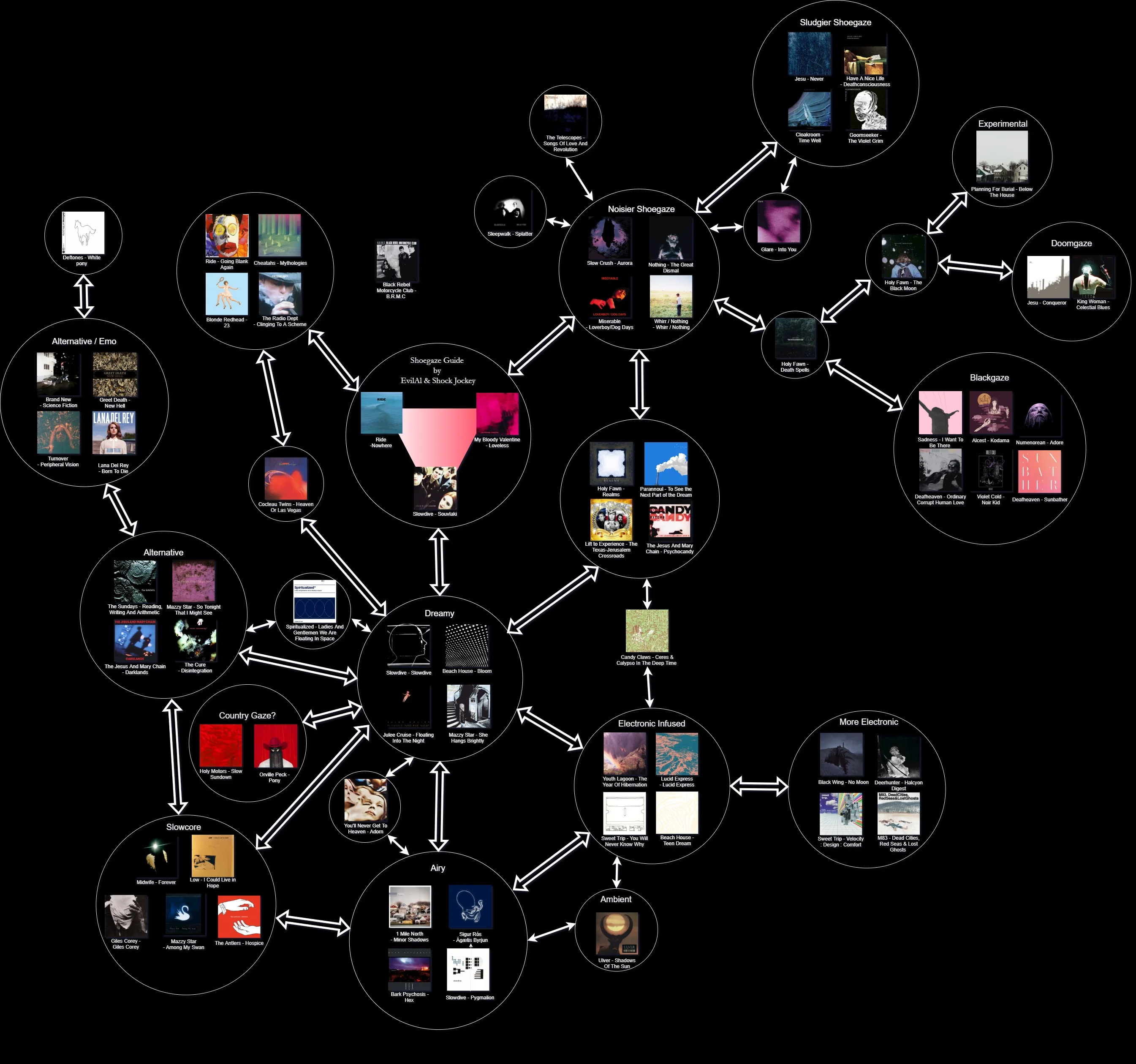
Notice how the chart is structured in the hope of discovering the perfect ‘vibe’… this album is the better fit if you want something dreamier, this is more noisy and jangly. The structure is not to discover new music but to discover more of the old music, tending sharply towards some kind of aesthetic purity. A lot of it is of course rendered odd by the central inclusion of my bloody valentine’s loveless, an album largely incomparable to everything before and after it (like most good albums, records that serve to imitate the sound of loveless don’t sound like anything but ripoffs of loveless). By saving loveless for the starting point, one is letting the listener through quite a disappointing spiral; the appeal of discovery is to listen to something new, not to gradually mull down something new to something old. The ‘perfect’ album is simply one for which the listener has the most love—by all accounts the sound of weatherday’s come in should be most pleasing to me, but its almost isolated frequency of noise does less than the more variable but less honest Painful by Yo La Tengo.
Ultimately, readers who wish to scratch that Harry Potter itch should probably just read Harry Potter, since nothing scratches that itch better. Nevertheless, there still remains an entire industry dedicated to Harry Potter knockoffs. What is this desire for ‘safe’ novelty? It is in fact the same tendency as my desire for Cybergaze Cinema, where the overwhelming presence of carefully arranged moe-elements is enough to induce some of that same feeling that was being chased—but being second-order arrangements of moe-elements, rather than a true original, there is also a fundamental lack of original vitality in the copies that does not scratch the itch so much as subdue it. And as copies are made of copies, hardly any of the aura of the work survives. Hence the desire to find the ‘perfect’ representative of the underlying aesthetic impulse is an ultimately failing one: the copies made by hyperfans claim to purify and isolate the impulse, but all they end up doing is sublimating it.
quality cybergaze
Ultimately what it comes down to is that there is only one Haru and my attempt to curate a Cybergaze Canon was in fact an entirely empty expression. Nothing is going to scratch that itch apart from Haru itself. But Haru did not emit from a vacuum: presumably there was a set of circumstances that resulted in this bare expression of cybergaze, considering that Haru was, at some point, produced, and had an author. Whether Haru is a ‘derivative’ of another, greater work is anybody’s guess, but there is occasionally some genetic drift that introduces some diversity into the artistic bloodstream. Hideki Anno may have used Gundam as a launching point but did create something original in EVA. Whether this art is a work of genius or simply the right expression at the right time is one of the grand debates of history. But it does seem to be undeniably true that there are amounts of anime fans who are not ‘otaku,’ whose consumption extends outward towards raw quality instead of simply moe-elements, just as there are readers who seek out quality instead of amateurish by-the-books fantasy literature15 or the self-possessed ‘intellectual’ moe-elements of modern Pulitzer fiction. What, then, is this ‘quality’? The problem is that such a thing cannot be rigorously categorized as nicely as moe-elements. Merely the vibe is not enough, though it forms a component—and the plot, the structure, authenticity, all conjoin together to result in something that may perhaps one day be called a ‘classic.’ Perhaps quality refers, ultimately, to that inimitable quality of work that makes it certainly worth looking into, if not enjoying: originality.
I wonder if there is a word for this in English: synthetic as colloquially used means ‘artificial,’ but here I am using it in a perhaps more organic meaning which is ‘something formed via the process of synthesis.’ Many such words have been bastardized in this manner. My least favorite example is ‘contemporary,’ which means ‘of the same time,’ but perhaps due to association with the art world has transformed into something meaning more like ‘of [our, or a recent] time’ since ‘modern’ has a connotation in art different from that which contemporary is used to refer to. Example: ‘the records of Livy agree with those of contemporary historians.’ Does this means historians of Livy’s time or of our time? Unclear!
Henceforth referred to as EVA.
Although I will be referencing Otaku throughout this post, I am not actually an otaku. I am generally indifferent to anime, though I watched the more popular ones like EVA or Naruto when I was younger, but it is not really a thing I consume: there is some aspect of cultural divide, as I find the quirks (like vague perversions or even long monologuing) kind of oddly stifling, and there’s also the fact that it’s a bit, I don’t know, flashier than a lot of the things I tend to read/watch? An odd objection to lay down against what is ostensibly a genre, but there’s also a broader anime sensibility which most of them either lean sharply into or are actively defined against. Although like anyone who is aesthetically inclined I do very much love Cowboy Bebop and the usual compilations of ‘80s anime characters lighting a nighttime cigarette to a background score of jazz-pop.
Or perhaps more liberally, ‘nerd culture.’
I do hope I’m using this right.
See Takashi Murakami. (2005). Little boy : the arts of Japan’s exploding subculture / Little boy : the arts of Japan’s exploding subculture. Japan Society ; New Haven, Ct. Wikipedia.
Someone very, very good at highlighting millennial New England falls and packaging them into breakup songs.
Apart from maybe starting a search engine for them. Courtesy, again, of Azuma. These weebs are nuts!
Who purportedly starts writing characters by making a list, LMFAO—I can confirm that of his very few strong suits, interesting characters is certainly not one of them.
And now we can be fairly certain that we are well and truly onto something, since Takashi Murakami designed the album cover of Kanye’s Graduation.
Which is actually an excellent book.
A crisis of unbearable waiting, then, since the main driver of their daily lives is whatever they’re out there camping for.
But the ‘otaku,’ of course, has bad taste. What’s going on? Capitalism contains several mechanisms for readjustment—democratizing taste, for instance, via trends such as poptimism as well as high/low culture mishmashes. Actually, the most popular things in the world are also good! But the authorities fail to label them so, allowing the parasocial fanbases of popular entities access to a certain victimization that ensures that they remain in the thought-spirals that enable rabid consumption in the first place.
Although the idea originates really from /mu/.
Perhaps I’ve dragged fantasy through the mud here. In fact fantasy can be quite good. The only reason I’m not still a fanboy of Tolkien’s Legendarium is because I’m older and therefore more busy and selective with my time than any impulse of artistic maturity—it remains as good as ever—and there are a number of ‘good’ such books published periodically; I really like some of Susanna Clark’s output, as well as have a soft spot for the Kingkiller Chronicle, although that may as well be a collection of moe-elements I myself find the most pleasing.