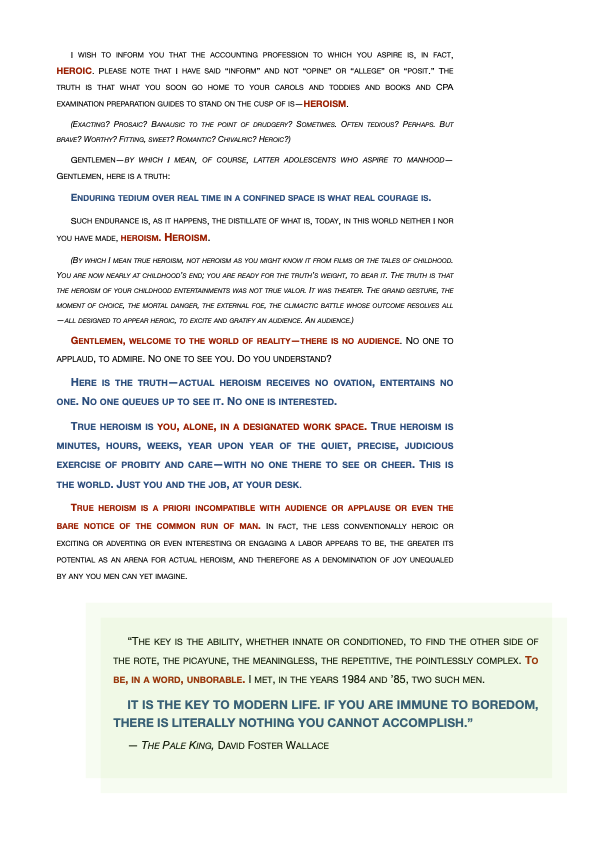
david foster wallace poster
Sorry for the more conventional blogging. I haven’t been writing anything here for a while primarily due to three reasons:

- I had a brief relationship that sent me into a downward spiral1, and
- I’ve been writing a lot of fiction, instead, and I recently bought the domain brucespringsteencoverband.com on which you will soon be able to read all my short (and long) fiction free of charge, except if you want to donate some pocket change. In fact I will soon migrate this blog as well to said website and attempt to scrub my identity off it—it’s not that there’s any kind of stigma about this, most of the stuff I write on this blog is by and large incomprehensible and therefore inoffensive, but I still don’t want to risk it with all these AI crawlers; presumably at some point Grokula or whatever the big new thing is will scrape through the entire archive of my posts and come up with some damning verdict like ‘this guy is too neurotic and spends all his time kvetching,’ at which point the only appropriate response for me will be to shamefully retire from blogging and instead become a coal miner2.
- I got into a barfight with a United States Marine3.
What I have been doing instead is recovering from a very, very bad winter, the worst on record (mentally and physically) while trying to rid myself of both the aforementioned relationship and also 10 days of mental persecution I lived through when my rationalist friend decided to spend Christmas with me. Why did I do that? I don’t know.
This was mostly a losing battle, until I decided to start reading some books. One of them was The Faces by Tove Ditlevsen—meh, overall, and she’s a bit too obscurant in the essentials. The other was a copy of DFW’s Oblivion I bought when I went to Amsterdam4. I haven’t finished Oblivion because I still haven’t read The Soul is Not a Smithy and The Suffering Channel, but I’ve been purposefully delaying them because Good Old Neon did such a number on me that it really left me all screwed-up. As you can see, I write like a person who has many of the same fundamental ailments as DFW, which I think is ADHD + some or the other Cluster B personality disorder, and so reading something like Good Old Neon, which is about a guy who is a compulsively manipulative performer convinced that he’s fraudulent, is like getting slapped in the face5. I actually don’t think I’m fraudulent so much so as have a tendency to behave like a wastoid, which I’ll get to in a minute. But in any case, this left me in circles of neuroticism that I had to piecemeal my way out of.
I’d like to give you a more accurate account of my holidays but unfortunately I can’t without wanting to spend copious amounts of time on things like how the other day I saw her in the elevator and had a whole dipping-the-madeleine moment because we’d made out in it before but also noticed that her hair color was lighter and this sent me into a shocking spiral of mixed tenderness—like I got knocked out full bugs bunny style—so I’ll just try to summarize it. Basically: existential crisis combined with crippling migraines.
What I’m building to via this whole thing is that I had a couple of transformative, miraculous experiences. First things first I went to the Notre Dame immediately after watching My Night at Maud’s around the New Year and this transformed in me in some fundamental sense. My Night at Maud’s is a movie about a guy who does math and has girl problems. So that’s already me. His particular type of girl problems are also absurdly specific, which is that he is (a) attracted almost exclusively to women who are bad for him, and (b) claims to be catholic and moral6 but he confuses being a romantic at heart with being moral, which is also me. The only thing I can safely say I am is profoundly monogamous, and I don’t know if that’s any kind of moral standard I’m hitting. In any case, this movie did a number on me because this for sure would happen to me. In fact many of my relationships proceed in this exact manner—Maud has some amount of interest in me but I screw it via some mechanism that I can’t describe correctly. The next day I went to the Notre Dame with my new digicam (thanks Jake!) from 2004 and had a transformative experience. I became a man in touch with God. Not so much in touch with God in that my belief in God is really dependent on my mood still, but certainly I began to see a moral dimension to my woes.

It was in this sort of mildly flayed state that I read Wallace’s Something to Do With Paying Attention, which knocked me out of the park. This was the closest I’ve ever gotten to a religious experience. The setup of this is that there’s this guy called Chris Fogle who’s describing how he joined the IRS after spending all of the ‘70s being what he terms as a ‘wastoid’ and which is way too accurate to all the slacking I myself do, which mostly involves sitting around and complaining about how postmodernism has destroyed all our meaning-making institutions and getting into poorly-thought-out relationships with the belief that the right girl will fix me7. I mean just read the beginning:
I’m not sure I even know what to say. To be honest, a good bit of it I don’t remember. I don’t think my memory works in quite the way it used to. It may be that this kind of work changes you. Even just rote exams. It might actually change your brain. For the most part, it’s now almost as if I’m trapped in the present. If I drank, for instance, some Tang, it wouldn’t remind me of anything—I’d just taste the Tang.
From what I understand, I’m supposed to explain how I arrived at this career. Where I came from, so to speak, and what the Service means to me.
I think the truth is that I was the worst kind of nihilist—the kind who isn’t even aware he’s a nihilist. I was like a piece of paper on the street in the wind, thinking, ‘Now I think I’ll blow this way, now I think I’ll blow that way.’ My essential response to everything was ‘Whatever.’
Like this is already some of the greatest stuff I’ve read in my life. This is astonishing. Incredible.
The novella proceeds in this in-and-out manner, and the interesting thing is that there’s nothing really ‘wacky’ about Chris’s life apart from a couple of minor incidents—he mostly just screws around like anyone in the ‘70s until his dad dies somewhat disappointed in him and that causes a crisis of faith. He then watches As the World Turns and has an epiphany—the CBS announcer says ‘You’re watching As the World Turns!’ and he realizes that he is, literally, watching as the world turns—watching, as in, just sitting around doing nothing. Finally he ends up accidentally sitting into the wrong Advanced Tax class (he was supposed to be taking Intro to Accounting) and on the final day of classes the substitute professor gives a speech that basically single-handedly convinces him to get a haircut, stop being the wastoid he was and join the IRS.
This is the speech.
Before you leave here to resume that crude approximation of a human life you have heretofore called a life, I will undertake to inform you of certain truths. I will then offer an opinion as to how you might most profitably view and respond to those truths.
You will return to your homes and families for the holiday vacation and, in that festive interval before the last push of CPA examination study—trust me—you will hesitate, you will feel dread and doubt. This will be natural. You will, for what seems the first time, feel dread at your hometown chums’ sallies about accountancy as the career before you, you will read the approval in your parents’ smiles as an approval of your surrender—oh, I have been there, gentlemen; I know every cobble in the road you are walking. For the hour approaches. To begin, in that literally dreadful interval of looking down before the leap outward, to hear dolorous forecasts as to the sheer drudgery of the profession you are choosing, the lack of excitement or chance to shine on the athletic fields or ballroom floors of life heretofore.
To experience commitment as the loss of options, a type of death, the death of childhood’s limitless possibility, of the flattery of choice without duress—this will happen, mark me. Childhood’s end. The first of many deaths. Hesitation is natural. Doubt is natural. You might wish to recall, then, in three weeks’ time, should you be so disposed, this room, this moment, and the information I shall now relay to you.
I wish to inform you that the accounting profession to which you aspire is, in fact, heroic. Please note that I have said “inform” and not “opine” or “allege” or “posit.” The truth is that what you soon go home to your carols and toddies and books and CPA examination preparation guides to stand on the cusp of is—heroism.
Exacting? Prosaic? Banausic to the point of drudgery? Sometimes. Often tedious? Perhaps. But brave? Worthy? Fitting, sweet? Romantic? Chivalric? Heroic?
Gentlemen—by which I mean, of course, latter adolescents who aspire to manhood—gentlemen, here is a truth: Enduring tedium over real time in a confined space is what real courage is. Such endurance is, as it happens, the distillate of what is, today, in this world neither I nor you have made, heroism. Heroism.
By which I mean true heroism, not heroism as you might know it from films or the tales of childhood. You are now nearly at childhood’s end; you are ready for the truth’s weight, to bear it. The truth is that the heroism of your childhood entertainments was not true valor. It was theater. The grand gesture, the moment of choice, the mortal danger, the external foe, the climactic battle whose outcome resolves all—all designed to appear heroic, to excite and gratify an audience. An audience.
Gentlemen, welcome to the world of reality—there is no audience. No one to applaud, to admire. No one to see you. Do you understand? Here is the truth—actual heroism receives no ovation, entertains no one. No one queues up to see it. No one is interested.
True heroism is you, alone, in a designated work space. True heroism is minutes, hours, weeks, year upon year of the quiet, precise, judicious exercise of probity and care—with no one there to see or cheer. This is the world. Just you and the job, at your desk. You and the return, you and the cash-flow data, you and the inventory protocol, you and the depreciation schedules, you and the numbers.
True heroism is a priori incompatible with audience or applause or even the bare notice of the common run of man. In fact, the less conventionally heroic or exciting or adverting or even interesting or engaging a labor appears to be, the greater its potential as an arena for actual heroism, and therefore as a denomination of joy unequaled by any you men can yet imagine.
To retain care and scrupulosity about each detail from within the teeming womball of data and rule and exception and contingency which constitutes real-world accounting—this is heroism. To attend fully to the interests of the client and to balance those interests against the high ethical standards of FASB and extant law—yea, to serve those who care not for service but only for results—this is heroism. This may be the first time you’ve heard the truth put plainly, starkly. Effacement. Sacrifice. Service. To give oneself to the care of others’ money—this is effacement, perdurance, sacrifice, honor, doughiness, valor. Hear this or not, as you will. Learn it now, or later—the world has time. Routine, repetition, tedium, monotony, ephemeracy, inconsequence, abstraction, disorder, boredom, angst, ennui—these are the true hero’s enemies, and make no mistake, they are fearsome indeed. For they are real.
Too much, you say? Cowboy, paladin, hero? Gentlemen, read your history. Yesterday’s hero pushed back at bounds and frontiers—he penetrated, tamed, hewed, shaped, made, brought things into being. Yesterday’s society’s heroes generated facts. For this is what society is—an agglomeration of facts.
But it is now today’s era, the modern era. In today’s world, boundaries are fixed, and most significant facts have been generated. Gentlemen, the heroic frontier now lies in the ordering and deployment of those facts. Classification, organization, presentation. To put it another way, the pie has been made—the contest is now in the slicing. Gentlemen, you aspire to hold the knife. Wield it. To admeasure. To shape each given slice, the knife’s angle and depth of cut.
A baker wears a hat, but it is not our hat. Gentlemen, prepare to wear the hat. You have wondered, perhaps, why all real accountants wear hats? They are today’s cowboys. As will you be. Riding the American range. Riding herd on the unending torrent of financial data. The eddies, cataracts, arranged variations, fractious minutiae. You order the data, shepherd it, direct its flow, lead it where it’s needed, in the codified form in which it’s apposite. You deal in facts, gentlemen, for which there has been a market since man first crept from the primeval slurry. It is you—tell them that. Who ride, man the walls, define the pie, serve.
Gentlemen, you are called to account.
This changed me. It really did. I can’t describe how I felt after reading this, and I don’t need to, because it’s exactly as Chris Fogle did—like something had happened, like someone was talking to me, like directly to me, and that things were suddenly different. It became clear to me how much of a wastoid I myself was, going around and getting into all these crappy relationships for God knows what reason, playing at being some kind of enlightened nihilist while I was actually just using that nihilism to escape the fundamental duties of living a life. All of a sudden I felt sick.
So I did what I could. The next day, I made a poster of the speech and put it on the wall. You can download it if you want yourself here, I’ve decided to make it available for everyone as a PDF.
I’m not joining the IRS, but something has been restored to my life. Routine. Repetition. Things make sense to me. Objects are concrete. Morality exists. Things are good and bad. I have an internal compass, and it’s finally pointed toward something.
I do want to say something about this realization because I’ve never conceived of myself as a ‘real’ slacker, just someone playing at one: I’m a very young PhD student in a difficult mathematical field; by all means I’m very successful. But if you’re in a bad place mentally like I very often am then all these things pile up and make it hard for you to get anything done. You feel all over the place, nothing makes sense. I’ve always suspected that drudgery puts you in the correct spot—like too much free time is bad for a person, it gives them all these ideas. Let me try to actually work myself, for a change; write more papers, do more math. Things in general feel very abstract. I have a bad tendency that when I’m in a relationship I feel grounded, but PhD life is quite lonely especially if you’re extremely young like I am—it’s hard to make this transition from having friends that you hang out with all day long to having people you meet like once or twice a week for an hour or two. This is also combined with the fact that due to various circumstances I have astonishing amounts of free time (I can produce a lot of work in hyperfocused periods which frees up my days). Having a girlfriend fixes that because every day I get home and meet her and it’s so nice, I get to spend time with someone I love. Things feel real when I have someone to share them with, tell her what happened at work, and then she tells me what happened at work with her, and then we cook dinner together. Somehow the lack of that fundamental structure just makes things feel ephemeral. Maybe I’m just too much of a talker or something, every time something happens no matter how minor I want to text and share it with her. It’s a lonely feeling not being able to do that, and I guess that’s why I’m always getting into these things thoughtlessly. I do know a lot of people with whom I can share things, but there’s something to be said about immediacy—just texting her and telling her ‘you won’t believe what happened’ is a big deal for me the moment it happens. Sigh. Sometimes things just suck, especially when you’re new to a city and your best friends are time zones apart.
Anyway, I’m back to serious work, all the slacking is over.
This one was actually really bad, largely because it started out as really good. We got along perfectly and there was basically every bit of that knockout ‘chemistry’ or whatever magical term they’re using these days when two people get together and all the romantic interactions are perfectly natural and easygoing while still being remarkably intense—you know the deal, or at least I hope you do. I mean it only lasted for a little while and we never actually got ‘together’ due to a variety of complicated and not so complicated reasons that will nevertheless be a hassle to describe and therefore I won’t. There were of course some positives to this situation—I can tell you about, for instance, how I found out that shopping with the right person can be a genuinely great experience, or how when she did it somehow I no longer minded talking throughout the length of a movie’s duration, many many such things that have basically left me locked in my room with migraines for days on end—but the fact that there were some positives means that the ending of the intense fling hit like a freight train8.
I have been thinking about coal miners a lot recently. I think the appropriate guilt has finally caught up: I now feel like I am somehow letting my ancestors down by being a researcher in a first-world country instead of being the coal miner I was born to be. I used to read these Percy Jackson books as a kid in which ADHD was revealed to be a sign that you’re a demigod and therefore suited to hyperfocusing on combat and physical activity. It is true: when I hit the gym I hit the gym hard. If only things were so simple and so nice, but at this point it’s pretty much confirmed that while I have mathematician/artist personality I absolutely have coal miner fundamentals. My grandparents were literal farmers. I should be Clark Kent, not Philip Roth.
This one’s more of a joke, but it did happen. Context: I went to a bar in my Michigan jersey and these guys were from Ohio so they were already pissed. I was somewhat late to a pub quiz and joined this team which weren’t doing all so well and answered a bunch of music questions: you won’t believe this but the songs to recognize were I Took a Pill in Ibiza by Mike Posner, Island in the Sun by Weezer, Kokomo by the Beach Boys and Dancing in the Dark by my boy Bruce. I don’t know how these guys can call themselves Marines and not recognize the last one. But in any case they came up to me and started saying things like ‘you gotta be careful ‘round these parts’ which is hilarious to say in a pub literally within 5 minutes’ walking distance of the Notre Dame, but like I’m also not starting a fight with actual Marines, even if they’re my height and age and everything. These guys are literal killers and very, very drunk. They screwed off after a bit of bickering, fortunately.
Manic episode. Don’t ask.
though not with a penis! My PhD advisor and I were having a discussion about our favorite words and he said that he really likes the French bifler, which means to get slapped in the face with a penis. My own interests are less lewd; I like ‘valley’ a lot, and also ressentiment. Also schadenfreude, though that’s a kitschy one.
Like someone you know? Half my identity is being from St. Louis. The other day I actually said to someone “I’m from St. Louis, you know, we believe in things down there. Holding hands and throwing rocks into the river means something to me.”
Unfortunately this turned out to be correct. When I was going out with the girl I’ve been complaining about in this whole post it somehow fixed me, like actually fixed me: suddenly my life was full of purpose again because the thought of doing things for her somehow changed me and got rid of all my nihilism.
Yes of course my coping mechanism of choice is lethal amounts of Bruce Springsteen. ‘At night I wake up with the sheets soaking wet and a freight train running through the middle of my head’—this is me every day.